


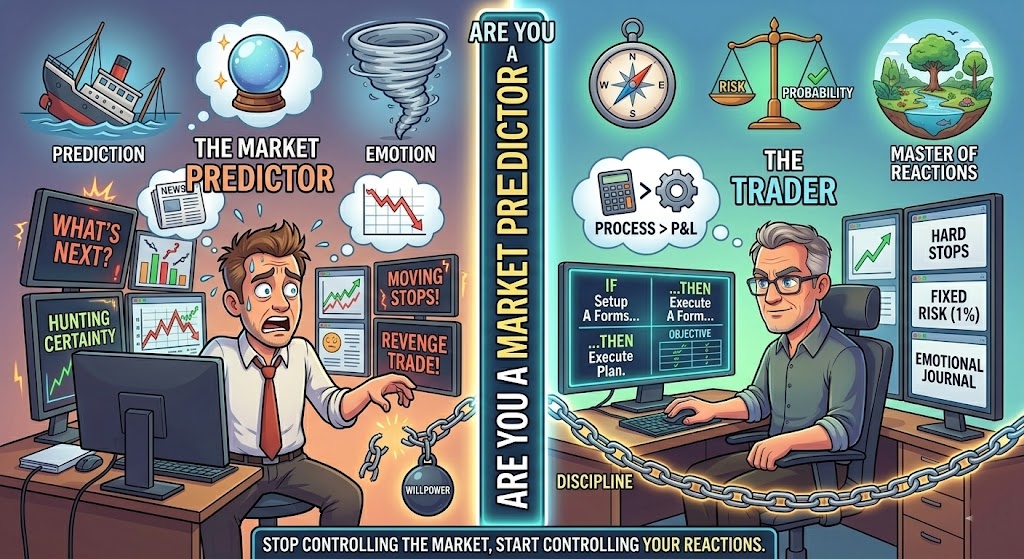
Are You a Market Predictor or a Trader?
In the world of finance, these two terms are often used interchangeably, but in reality, they represent two completely different psychological universes. One leads to a cycle of frustration and “hoping,” while the other leads to consistent, mechanical execution.
Understanding which one you are—and how to switch—is often the final hurdle between a struggling account and a professional career.

1. The Market Predictor: The Search for Certainty
The Market Predictor treats the charts like a crystal ball. They spend hours analyzing news, indicators, and social media sentiment to answer one question: “What is the market going to do next?”
- The Trap: Predictors feel a psychological need to be “right.” If they go long on Gold and it drops, they feel personally attacked by the market.
- The Behavior: They often move their stop-losses because they “know” the price will eventually turn back. They revenge trade to prove the market wrong.
- The Result: High stress and inconsistent results. Because no one can truly predict the future, the Predictor is always one “surprise” away from a mental breakdown.
2. The Trader: The Master of Probabilities
A Trader doesn’t care what the market does next. They only care about what they will do when the market reaches a specific zone. They aren’t in the business of guessing; they are in the business of risk management.
- The Mindset: Traders understand that any single trade has a random outcome. They know their edge only plays out over a series of 20, 50, or 100 trades.
- The Behavior: They have a “if-then” plan. If price hits the 61.8% Fibonacci level and shows a rejection, then they enter. If it hits the stop-loss, they exit without emotion.
- The Result: A “Silent Operator” who remains calm. Whether the current trade is a win or a loss is irrelevant, as long as the process was followed.
How to Transition from Predictor to Trader
If you find yourself constantly trying to “guess” the next candle, here is how you can pivot your strategy toward a professional mindset:
A. Embrace the “I Don’t Know” Philosophy
The most liberating thing a trader can say is, “I have no idea where the market is going, and I don’t need to know to make money.” Your job isn’t to be a psychic; it’s to be a casino—accepting small losses as the “cost of doing business” while letting your edge provide the profit over time.
B. Use Mechanical Constraints
Predictors rely on “gut feelings,” which change based on how much coffee they’ve had. Traders use Mechanical Rules:
- Fixed Risk: Never risking more than a set percentage (e.g., 1%) per trade.
- Objective Entries: Using specific tools like Smart Money Concepts (SMC) or Order Blocks that require zero “interpretation.”
- Hard Stops: Setting a stop-loss that is never, ever moved.
C. Focus on the Process, Not the P&L
A Predictor judges their day by how much money they made. A Trader judges their day by how well they followed their rules. If you followed your plan perfectly but lost money, you had a successful day. If you broke your rules and made money, you had a failed day because you reinforced a bad habit.
The Final Verdict
The market doesn’t reward the smartest person in the room; it rewards the most disciplined.
The Predictor is a victim of the market’s movements. The Trader is a master of their own reactions. To move from the 95% who fail to the 5% who succeed, you must stop trying to control the market and start controlling yourself.
ADMIN
26/06/26