



Reversal Structure | Trend shift from bullish to bearish
Market structure is the foundation of technical analysis. While markets spend most of their time trending, the transition phases—or reversals—offer the highest risk-to-reward opportunities. In this guide, we break down the four primary bearish reversal patterns: from the classic Head and Shoulders to the high-probability ‘Break and Retest’ model.
Mastering Reversal Types is the difference between catching a falling knife and riding a new wave of profit. Here are the 4 essential structures every price action trader needs to memorize.
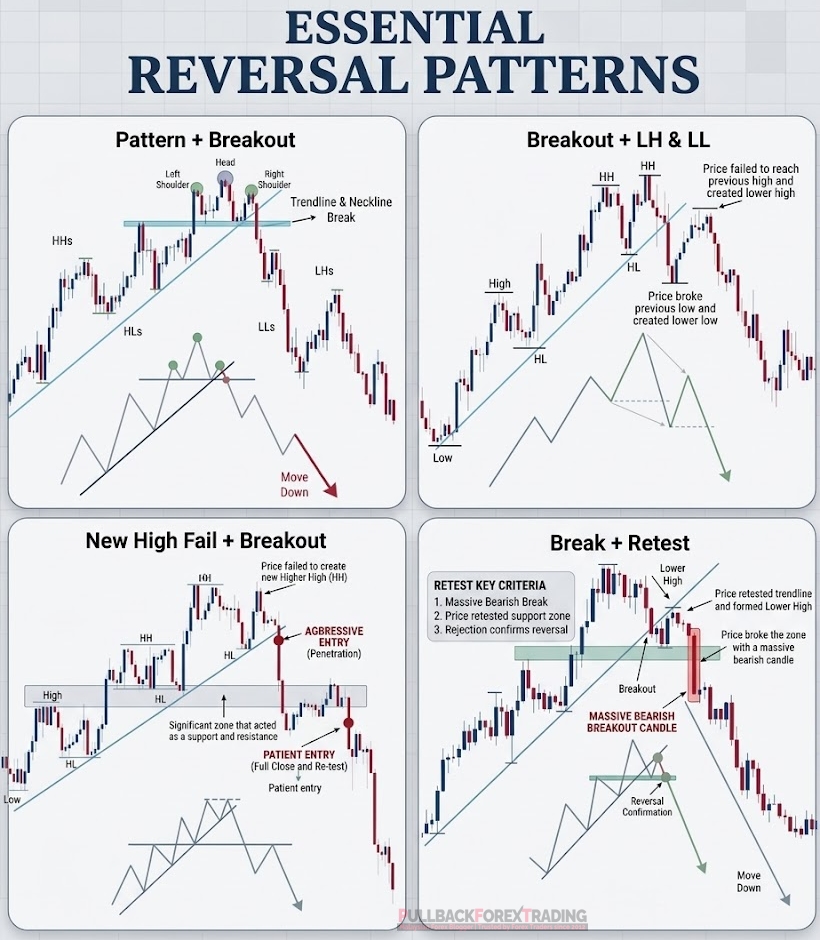
1. Pattern + Breakout (Head and Shoulders)
This strategy relies on a classic price action formation.
- The Structure: The price creates three peaks. The middle peak (Head) is the highest, while the two outside peaks (Shoulders) are lower and roughly equal in height.
- The Trigger: A reversal is confirmed when the price breaks below the “Neckline”—the support level connecting the lows of the shoulders.
- Key Indicator: The break of the upward trendline usually happens simultaneously with the neckline break, signaling a massive shift in momentum.
2. Breakout + LH & LL
This is the most “purist” approach to trend following, focusing strictly on Market Structure.
- The Shift: The price fails to make a new Higher High (HH) and instead creates a Lower High (LH).
- The Confirmation: Once the price drops below the previous Higher Low (HL), it creates a Lower Low (LL).
- Market Sentiment: This sequence proves that buyers no longer have the strength to push prices up and sellers are now in control.
3. New High Fail + Breakout
This focuses on the “failure” of the bulls at a critical resistance zone.
- The Setup: Price attempts to reach or exceed a previous peak but fails, signaling exhaustion.
- Entry Styles: * Aggressive Entry: Entering immediately as the price penetrates the support zone.
- Patient Entry: Waiting for a full candle close below the support/resistance zone to ensure it isn’t a “fakeout.”
4. Break + Retest
Widely considered the most conservative and high-probability entry method.
- The Break: Price breaks through a major support zone or trendline with a “massive bearish candle.”
- The Retest: Instead of chasing the move, the trader waits for the price to bounce back up to the old support (which now acts as new resistance).
- The Rejection: The entry is taken when the price hits that old zone, forms a Lower High, and starts moving back down.
| Strategy | Risk Level | Confirmation Level | Best For… |
| Pattern + Breakout | Moderate | Neckline Break | Visual pattern traders |
| LH & LL | Low | New Lower Low | Structural/Systematic traders |
| New High Fail | High | Zone Penetration | Catching the move early |
| Break + Retest | Lowest | Rejection of old support | Risk-averse traders |
ADMIN
08/04/26