


Master the QM Pattern: 4 High-Probability Buy Setups Using Price Action
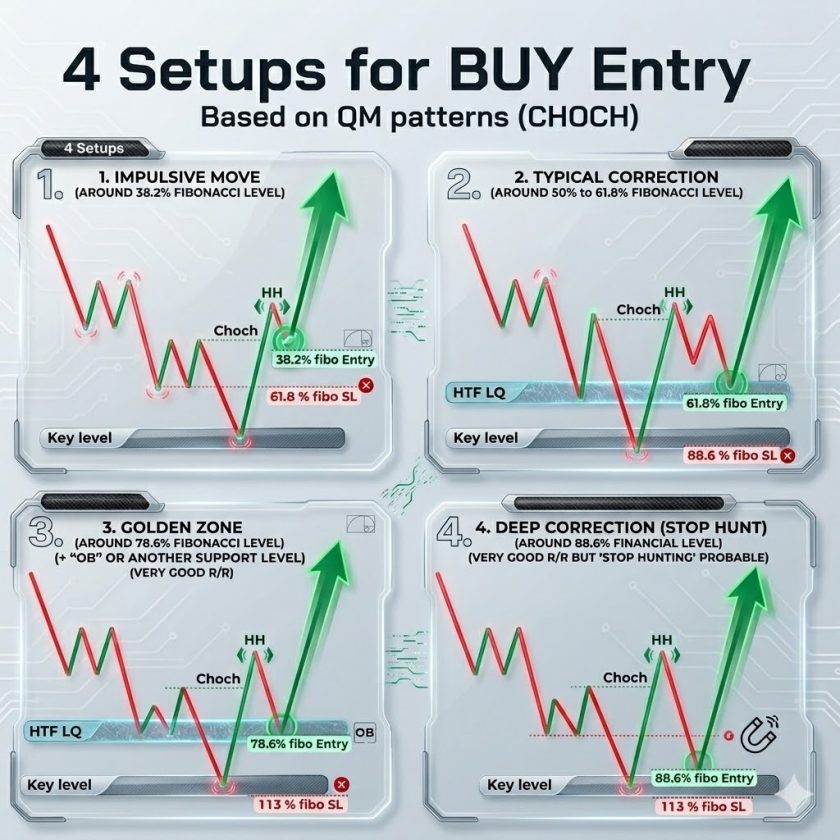
4 Setups for QM Pattern Buy Entry (Based on Choch)
Navigating the markets requires a methodical approach, and mastering specific chart patterns can give you a significant edge. The Quasimodo or QM pattern (often integrated with the concept of a Change of Character, or Choch) is a powerful tool for identifying high-probability trend reversals.
This guide will break down four distinct trade setups derived from a popular technical chart, explaining how to use price action, high-timeframe context, and Fibonacci levels to pinpoint the ideal Buy Entry with incredible precision.

What is a QM Pattern and Choch?
Before we dive into the setups, let’s quickly define the core concepts from the infographic.
- QM Pattern: This pattern forms after a sustained trend. A classic bullish QM pattern involves a series of lower highs and lower lows, culminating in a new (but often weak) low, followed by a sharp break above a previous key structural high (the Choch). The subsequent retracement is where you look for an entry.
- Choch (Change of Character): This is the heart of the setup. It’s the first time the price breaks the market structure of the previous trend. After a downtrend of Lower Highs and Lower Lows, a break above a Lower High is a Choch. It’s a signal to stop thinking ‘sell’ and start preparing to ‘buy’.
- HH (Higher High): The confirmation move after the Choch, creating a new peak that validates the shift in structure.
Understanding the Core Mechanics
Before diving into the setups, let’s define the “engine” behind these moves:
- The Choch (Change of Character): In a downtrend, price creates lower highs and lower lows. A Choch occurs when the price finally breaks above the last lower high. This is the first signal that the bears are losing control.
- HH (Higher High): This confirms the Choch. It shows that buyers have enough strength to push the price into new territory.
- Key Level: A major horizontal support area where institutional buying has historically occurred.
- HTF LQ (High-Timeframe Liquidity): Areas where “stop losses” are resting. Banks often drive price into these zones to pick up orders before moving the other way.
Mastering the 4 Buy Setups
The provided chart (image_0.png) visualizes four specific ways to trade a QM pattern retracement after a confirmed Choch. Each setup has its own characteristics, key levels, and risk parameters.
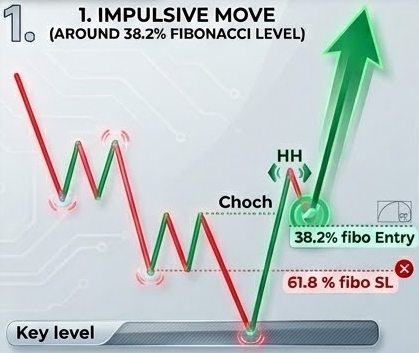
Setup 1: The Impulsive Move Entry (Around 38.2% Fibonacci Level)
Concept: This setup focuses on trading a strong, early, and decisive market reversal. The price forms a sharp new low, makes a clean Choch, and runs up strongly to a Higher High (HH). The market is moving fast.
- The Structure: Notice the deep ‘V’ shape. The push-up from the low is powerful.
- The Context: This is an aggression-driven move. Price is reacting sharply away from the “Key level.”
- The Entry: We don’t wait for a deep retracement. The entry is around the 38.2% Fibonacci level of the previous bullish impulse (from the low to the HH).
- The Stop Loss: Placed just below the 61.8% Fibonacci level (or the preceding swing low of the impulse) to give the trade room to breathe, but not too much. This is a very tight setup.
- Best For: Markets experiencing significant, news-driven momentum where you expect the new trend to be fast and shallow.
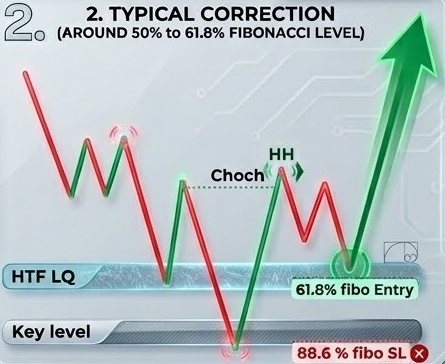
Setup 2: The Typical Correction Entry (Around 50% to 61.8% Fibonacci Level)
Concept: This is the classic textbook retracement setup. The market makes a structured push to a Higher High (HH) after the Choch, and you’re waiting for a more standard, healthy pullback.
- The Structure: More jagged, but still creating clear Higher Highs.
- The Context: Notice the inclusion of a “Key level” and “HTF LQ” (High-Timeframe Liquidity) box. The ideal retracement targets this liquidity zone, which is just above a key support level. This provides “dual-confirmation.”
- The Entry: The “sweet spot” is the “Typical Correction” or “Oppo” (Opportunity) zone, located around the 50% to 61.8% Fibonacci levels. This is where many institutional algorithms and retail traders look to buy.
- The Stop Loss: Placed at the 88.6% Fibonacci level (or slightly below it), beyond the key level, offering good protection.
- Best For: Most market conditions. A reliable and widely traded QM setup.
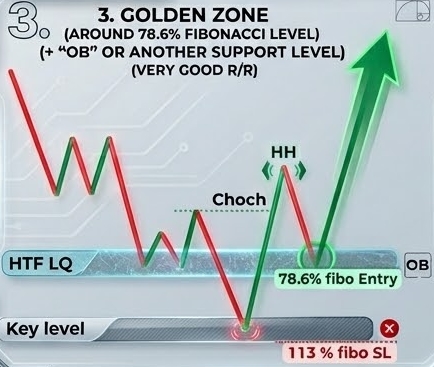
Setup 3: The Golden Zone Entry (Around 78.6% Fibonacci Level)
Concept: This setup is all about deep patience. We are looking for a deep pullback, targeting specific confluence areas for maximized risk/reward.
- The Structure: A complex correction that looks like it might fail, creating anxiety for weak hands.
- The Context: Critically, this setup requires the confluence of the Fibonacci zone and an “OB” (Order Block) or another significant support level from the HTF (High-Timeframe). It explicitly states “PLUS ‘OB’ OR ANOTHER SUPPORT LEVEL.” This depth provides incredible Risk/Reward.
- The Entry: The target is the 78.6% Fibonacci level. Buying this deep after a Choch and Higher High offers a massive potential move relative to the tight risk.
- The Stop Loss: Placed beyond the ultimate key level at the 113% Fibonacci expansion/extension of the impulsive low to HH. This is a protective “breaker” stop.
- Best For: Traders who prioritize high R/R over a high frequency of setups and have patience.
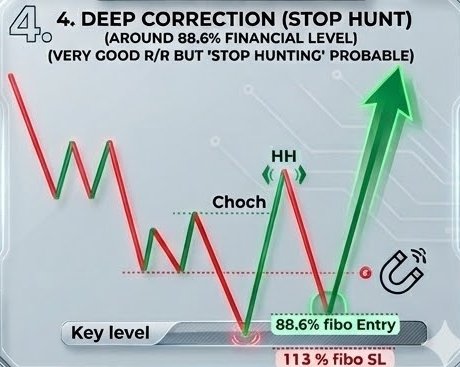
Setup 4: The Deep Correction & Stop Hunt Entry (Around 88.6% Fibonacci Level)
Concept: This is a masterful trading setup. It’s designed to profit from the manipulative behavior of ‘Smart Money’ (large players). The goal is to buy where most retail traders are being stopped out.
- The Structure: The retracement is so deep it nearly takes out the previous low, making retail traders panic and trigger their stop losses.
- The Context: This setup is specifically called “STOP HUNT.” Price dips below the Key Level to tap into deep liquidity and clear out stops. Chart 4 shows this dip clearly.
- The Entry: The entry is a “Sniper entry” at the 88.6% Fibonacci level. You are buying when the panic is highest.
- The Stop Loss: Positioned safely below the previous low at the 113% Fibonacci extension. This gives you maximum protection.
- Best For: Traders who understand institutional behavior and have a very high tolerance for risk (though the calculated risk/reward is superb).
| Setup | Description | Fibo Entry Zone | Key Feature | Risk/Reward |
| 1. Impulsive Move | Fast reversal, shallow pullback | 38.2% Fibo | Speed, clean “V” shape | Good |
| 2. Typical Correction | Structured pullback to key liquidity | 50% – 61.8% Fibo | Reliability, classic textbook QM | Very Good |
| 3. Golden Zone | Deep correction with HTF support | 78.6% Fibo | Patient wait, confluence with OBs | Excellent |
| 4. Deep Correction (Stop Hunt) | Deepest pullback, taking out minor stops | 88.6% Fibo | Sniper entry, profiting from liquidation | Excellent (Top Tier) |
By identifying the market structure, the key levels, and the character of the move (Impulsive vs. Corrective), you can choose the precise QM setup that offers the best opportunity. The combination of these five elements—Key Level, Choch, HH, HTF Liquidity, and Fibonacci—gives you a complete trading plan. Happy trading!
ADMIN
08/04/26