



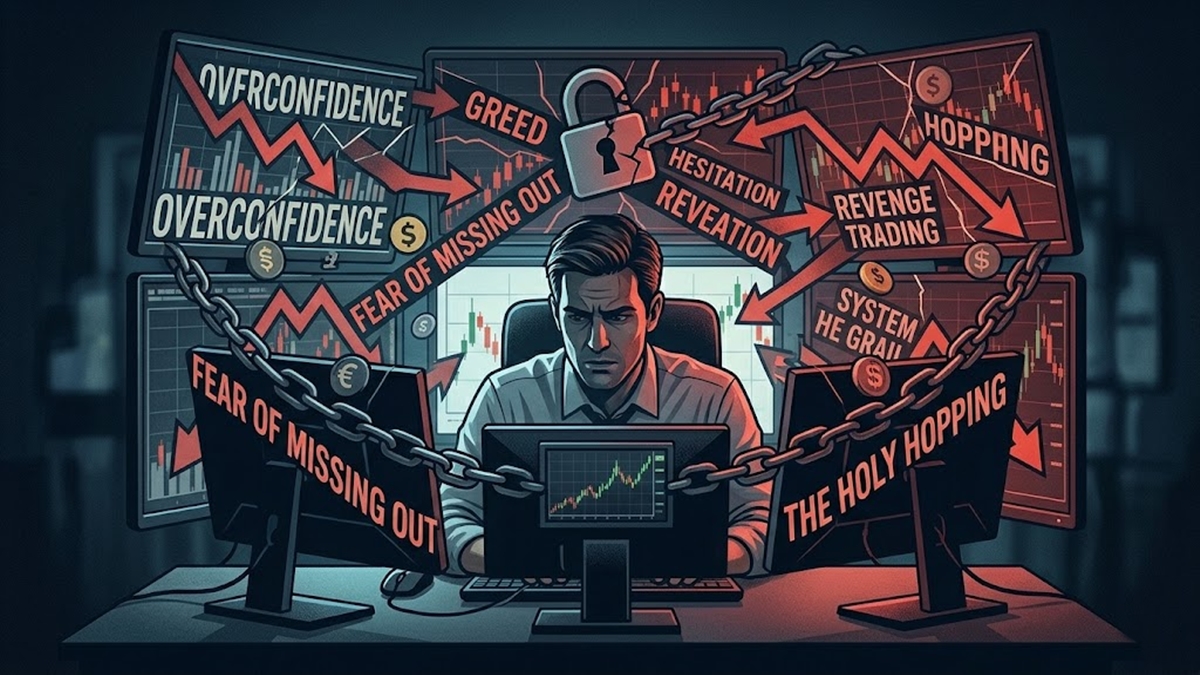
The Psychological Trap in forex trading and how to deal with it
Forex trading is often described as 10% strategy and 90% psychology. Even the most robust mechanical systems can fail if the person pulling the trigger is compromised by emotional biases.
Here are the most common psychological traps in trading and practical ways to neutralize them.
1. The Revenge Trading Trap
This happens immediately after a loss. You feel “robbed” by the market and attempt to win back the money by immediately re-entering with a larger position size.
- How to deal with it: Implement a “Three Strikes” rule. If you lose three trades in a single session, you must close your platform for at least 4 hours. Physically walking away breaks the emotional loop.
How to Implement the Rule
The rule is simple: If you hit three consecutive losses or a total loss limit for the day, you must immediately close all charts and stop trading for at least 24 hours.
- Strike 1: A normal part of the business. You analyze the loss, ensure you followed your plan, and look for the next setup.
- Strike 2: Your confidence starts to dip. You might start questioning your bias or looking for “confirmation” that isn’t there.
- Strike 3: The Circuit Breaker. At this point, your brain is likely seeking “retribution” against the market. You stop. No exceptions.

2. The FOMO Trap (Fear of Missing Out)
When you see a massive candle moving without you, the impulse is to jump in late. This usually results in entering at the “exhaustion point” right before the market reverses.
- How to deal with it: Stick to Time-Based entries. If your strategy requires an entry on the H1 candle close and you miss it, the trade is dead. Remember: the market will always provide another setup tomorrow.
3. The Gambler’s Fallacy
This is the belief that because the market has gone “too high,” it must come down, or because you’ve had four losses in a row, the fifth must be a winner.
- How to deal with it: Treat every trade as an independent event. The outcome of Trade A has zero statistical impact on the outcome of Trade B. Use a fixed Risk-to-Reward ratio (like 1:2 or 1:3) so that the math handles the probability, not your intuition.
4. The “Holy Grail” Syndrome
Many traders fall into the trap of constantly switching strategies (system hopping) as soon as they hit a losing streak, searching for a 100% win-rate indicator.
- How to deal with it: Focus on Mechanical Consistency. Backtest a single strategy (like SMC or Price Action) for at least 100 trades. Accept that losses are simply the “cost of doing business,” much like rent is for a physical shop.
5. Recency Bias
The tendency to over-emphasize your most recent results. If your last trade was a huge win, you might become overconfident and double your risk. If it was a loss, you might hesitate on a perfect setup.
- How to deal with it: Keep a Trading Journal. When you look at your data over six months, a single win or loss looks like a tiny dot on a graph. This perspective helps you stay detached from the immediate result.
| Trap | Emotional Root | Solution |
| Revenge Trading | Anger / Ego | Hard stop limits for the day. |
| FOMO | Greed / Anxiety | Rules-based entry criteria only. |
| Over-leveraging | Impatience | Fixed % risk per trade (e.g., 1%). |
| Hesitation | Fear of Loss | Automate orders (Buy/Sell Limits). |
Pro Tip: If you find yourself feeling physical symptoms—a racing heart, sweaty palms, or a “gut feeling”—it is a sign that your position size is too large. Lower your risk until you feel bored while trading; boredom is often a sign of a disciplined trader.
ADMIN
03/04/26
