


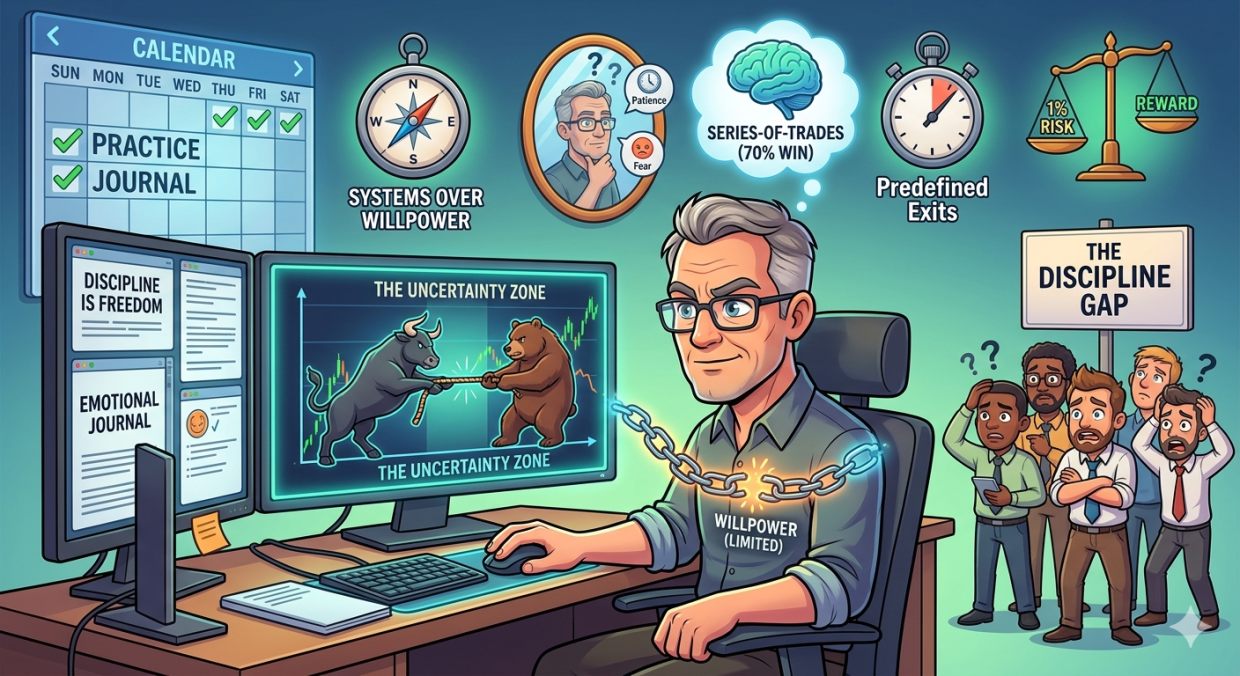
The Discipline Gap: Why Your Strategy Isn’t the Reason You’re Losing
Most traders spend years hunting for the “Holy Grail”—that one perfect indicator or Smart Money setup that never fails. But according to the late trading psychology pioneer Mark Douglas, your lack of profits isn’t a knowledge problem; it’s a discipline problem.
In a powerful masterclass on trading psychology, Douglas explains that if you want to make a living from the markets, you have to stop trying to “predict” the next move and start mastering the person staring back at you in the mirror.

1. The Illusion of Control
The market is a sea of infinite variables. No matter how perfect a “Bullish Hammer” or “Order Block” looks on a weekly timeframe, the outcome of that specific trade is uncertain.
Douglas argues that struggling traders fail because they need to be right. When the market moves against them, they move their stop-loss or “hope” for a reversal. Professional traders, however, accept that losses are simply the cost of doing business—much like a restaurant expects a certain amount of food spoilage.
2. Thinking in Probabilities
To bridge the gap between struggling and consistency, you must shift your mindset from “Trade-by-Trade” to “Series-of-Trades.”
- The Math: Even a strategy with a 70% win rate will lose 30% of the time.
- The Reality: You have no way of knowing which trades will be the losers.
Once you truly believe this, you stop being emotionally attached to any single trade. You stop revenge trading after a loss and stop getting overconfident after a win. You simply execute the process.
3. The “Stay in Your Lane” Rule: Systems Over Willpower
Many believe discipline is about “gritting your teeth” and trying harder. Douglas disagrees. Willpower is a limited resource that eventually runs out. Real discipline comes from removing choice through rigid systems:
- Mechanical Entries: Use objective criteria (e.g., specific Fibonacci levels) with zero room for “gut feelings.”
- Predefined Exits: Know your Stop Loss and Take Profit before you even click “buy.”
- Risk Caps: Use a fixed risk percentage (like 1%) and a maximum number of trades per day. Once you hit the limit, you walk away—no exceptions.
4. The Market as a Mirror
One of Douglas’s most profound points is that the market does not change you; it reveals you. > “If you are impatient in life, you will be impatient in trading. If you avoid difficult conversations in life, you will avoid cutting losses in trading.”
Trading is the ultimate feedback mechanism. It highlights your greed, your fear, and your inability to accept being wrong. To grow as a trader, you must first grow as a person.
5. Beyond the P&L: The Emotional Journal
While most traders track their pips, successful ones track their emotions. Douglas recommends a “Psychological Journal” to identify patterns:
- Are you over-leveraging after a winning streak?
- Are you hesitant to enter a valid setup after a loss?
By writing down how you feel during a trade, you make the invisible patterns visible. Once you see the pattern, you can create a rule to break it.
Final Thought: The Freedom of Discipline
Discipline isn’t restrictive; it’s freeing. When you follow a mechanical process, you stop worrying, second-guessing, and hoping. You become a “silent operator” who executes with calmness. The money is simply the byproduct of a mind that has learned to stay centered in the face of uncertainty.
ADMIN
06/04/26