



Mastering the Breakout: A Guide to Trading Market Momentum
In technical analysis, a breakout is one of the most powerful signals a trader can identify. It marks the moment when price escapes a confined range, signaling that the balance of power between buyers and sellers has shifted.
Understanding how to read these movements—and more importantly, how to enter them safely—is the difference between a profitable trend and a costly “fakeout.”
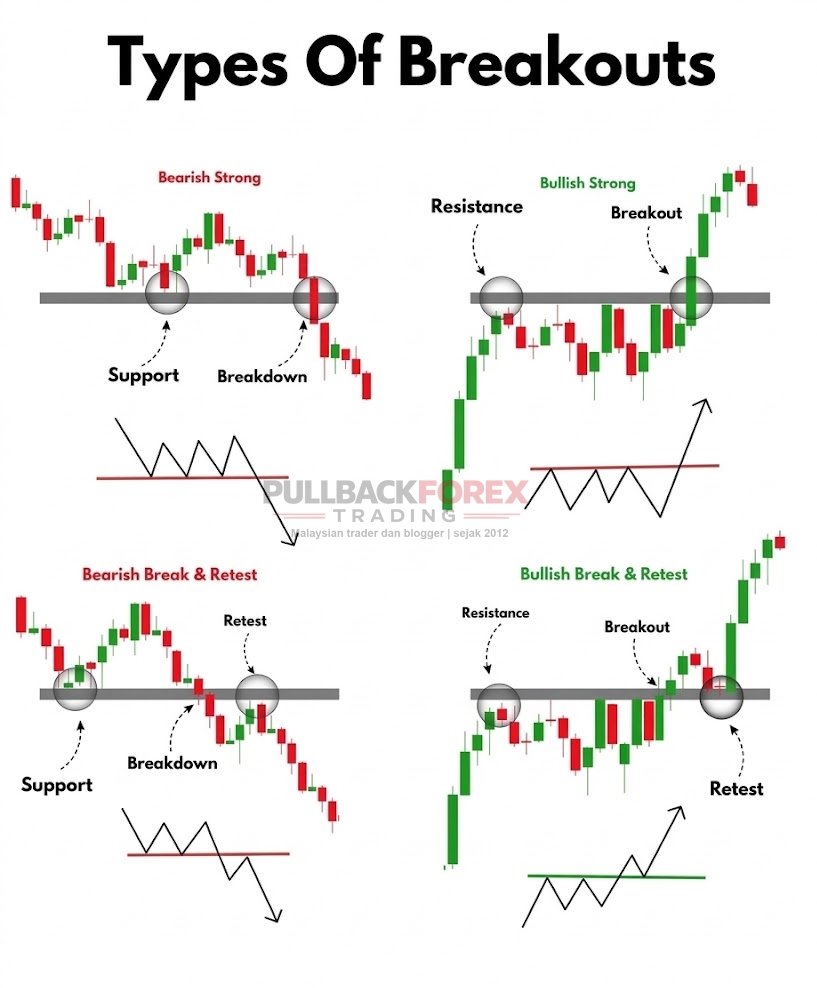
1. The Anatomy of a Breakout
Every breakout involves two key players: Support and Resistance. These are horizontal zones where the market has historically struggled to pass.
- Resistance: The “ceiling.” Sellers are concentrated here, pushing prices down.
- Support: The “floor.” Buyers are concentrated here, propping prices up.
A breakout occurs when the price “breaks” through these levels with enough momentum to close decisively on the other side.
2. Two Primary Styles of Entry
When a breakout occurs, traders generally follow one of two philosophies:
A. The Aggressive Entry (Strong Breakout)
This happens when price blasts through a level with high volume and speed.
- Pros: You ensure you don’t “miss the boat” on a high-momentum move.
- Cons: You are often buying at a high price or selling at a low price. If the market suddenly reverses (a “false breakout”), your stop loss may be very far away.
B. The Conservative Entry (Break & Retest)
Experienced traders often wait for the Retest. Once price breaks a level, it frequently returns to that level to “test” it from the other side.
- The S/R Flip: This is a golden rule in trading—broken resistance often becomes new support, and broken support often becomes new resistance.
- Pros: It provides a much better risk-to-reward ratio. You can place a tighter stop loss just behind the level, and you have confirmation that the market is ready to continue the move.

3. Bullish vs. Bearish Scenarios
The Bullish Breakout
- Resistance Level: Price hits a ceiling multiple times.
- The Break: A strong green candle closes above the resistance.
- The Retest: Price dips back to the old resistance line but stays above it.
- Confirmation: Price begins moving upward again, confirming the uptrend.
The Bearish Breakdown
- Support Level: Price bounces off a floor multiple times.
- The Break: A strong red candle closes below the support.
- The Retest: Price rises back toward the old support line but fails to break back inside.
- Confirmation: Price continues its descent, confirming the downtrend.
4. How to Avoid “Fakeouts”
Not every break is a true breakout. To increase your accuracy, look for these three filters:
- Candle Close: Never trade a breakout while the candle is still moving. Wait for the candle to close outside the level to confirm the break is real.
- Volume: A true breakout is usually accompanied by an increase in trading volume, showing that “big money” is behind the move.
- Market Structure: Ensure the breakout aligns with the higher-timeframe trend. If the weekly trend is down, a bullish breakout on a 15-minute chart is higher risk.
Summary:
| Feature | Strong Breakout (Aggressive) | Break & Retest (Conservative) |
| Speed | Instant execution | Requires patience |
| Risk | Higher (potential for fakeouts) | Lower (confirmed level flip) |
| Reward | High, if the move is parabolic | High, due to better entry price |
| Win Rate | Moderate | Higher |
The Bottom Line: While the “Strong Breakout” looks exciting, the “Break & Retest” is often the hallmark of a professional, mechanical trading strategy. By waiting for the market to prove its new direction, you protect your capital and trade with the wind at your back.
ADMIN
22/06/26